The Guardians on Trial by Altman William H. F
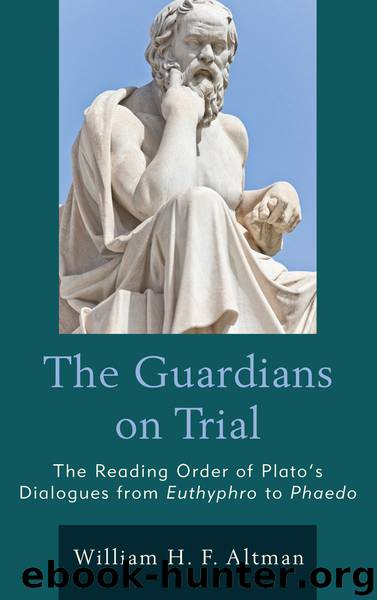
Author:Altman, William H. F.
Language: eng
Format: epub
ISBN: 9781498529525
Publisher: Lexington Books, a division of Rowman & Littlefield Publishers, Inc.
“But where did this visitor from Athens get Kleinias’ name?” For this Golden Question, Whitaker deserves the highest praise.
It is frequently remarked that the Stranger’s two interlocutors are his inferiors with respect to philosophical insight (e.g., 223n51), but insufficient attention has been paid to the fact that he is likewise their superior when it comes to rough and tumble political skill;171 Whitaker’s Golden Question begins to redress this deficit. Consider in this connection the late introduction of the Nocturnal Council: over the years, its role in the polity has been debated, and its institution has frequently been criticized as inconsistent with the rest of the city’s political institutions.172 But if we shift our attention to the possibility that the Stranger’s purpose in the dialogue is to achieve precisely the result he in fact achieves at its end, then its late introduction indicates his political dexterity.
Consider the following: from the first introduction of “the curator of all the education of women and men” (765d4-5), the Stranger insists that both the one who has been chosen for the post and the one choosing should think (“let him consider” at 765d8) “that this is by far the greatest office [ἡ ἀρχή] of the highest offices in the city” (765e1-2). If in fact this were actually to be the greatest office, it would constitute a political blunder: there can be only one such officer at a time, only the Stranger would be suitable for the post, and indeed he is soon enough envisioning himself instructing this magistrate (809a1-b3). The introduction of the Nocturnal Council serves to diminish this magistrate’s assumed power, and although this sitting curator (ἐπιμελετής) and his predecessors will be included when its membership is finally described (951e1-3), the torch has clearly been passed into the hands of others. Indeed the very fact that the highest authority in the state is a council makes it a political masterstroke. Consider in this regard another class of magistrate who, like the curator, will be ex officio members of the Council: the head priests (cf. 951d7-8 and 961a3).
In Republic, the attention lavished on education in books 2 and 3 serves to draw Socrates’s audience into the tale of his imaginary City: Polemarchus and the rest will be imagining themselves as its Guardians.173 In Laws, the Athenian Stranger also has a care for his immediate audience, and given the fact that Cleinias has a considerable share of the political power needed to bring the city into existence, both he and Megillus will be even more insistently asking themselves how they would or will fit into the polity being created in words. As a skilled politician, the Stranger leads them a merry chase. Throughout the discussion of magistrates in book 6, it gradually becomes clear that the body that approves the various candidates for office—a pseudo-Athenian δοκιμάσια174—exercises the real power in Magnesia. Before entering office, officials must be subjected to “scrutiny” by other officials (first mentioned at 753e1). Even on those occasions involving the democratic lot,175 the
Download
This site does not store any files on its server. We only index and link to content provided by other sites. Please contact the content providers to delete copyright contents if any and email us, we'll remove relevant links or contents immediately.
| Anthropology | Archaeology |
| Philosophy | Politics & Government |
| Social Sciences | Sociology |
| Women's Studies |
The remains of the day by Kazuo Ishiguro(8999)
Tools of Titans by Timothy Ferriss(8396)
Giovanni's Room by James Baldwin(7346)
The Black Swan by Nassim Nicholas Taleb(7129)
Inner Engineering: A Yogi's Guide to Joy by Sadhguru(6794)
The Way of Zen by Alan W. Watts(6614)
The Power of Now: A Guide to Spiritual Enlightenment by Eckhart Tolle(5781)
Asking the Right Questions: A Guide to Critical Thinking by M. Neil Browne & Stuart M. Keeley(5775)
The Six Wives Of Henry VIII (WOMEN IN HISTORY) by Fraser Antonia(5515)
Astrophysics for People in a Hurry by Neil DeGrasse Tyson(5189)
Housekeeping by Marilynne Robinson(4447)
12 Rules for Life by Jordan B. Peterson(4304)
Ikigai by Héctor García & Francesc Miralles(4274)
Double Down (Diary of a Wimpy Kid Book 11) by Jeff Kinney(4272)
The Ethical Slut by Janet W. Hardy(4253)
Skin in the Game by Nassim Nicholas Taleb(4248)
The Art of Happiness by The Dalai Lama(4130)
Skin in the Game: Hidden Asymmetries in Daily Life by Nassim Nicholas Taleb(4006)
Walking by Henry David Thoreau(3962)
